
From 12 August 2026, the Packaging and Packaging Waste Regulation (EU) 2025/40 applies across all twenty-seven Member States. It replaces the Packaging Directive that has governed European packaging since 1994, and because it is a regulation rather than a directive, it applies directly. There is no national transposition, no local interpretation, and no grace period.
For most organisations the significant change is not environmental. It is procedural. Packaging has historically been treated as a purchasing decision. Under PPWR it carries conformity obligations of its own, evidenced in the same way as the product it contains.
A Familiar Architecture Applied to a New Object
Organisations already operating under harmonised EU product legislation will recognise the structure PPWR imposes. It is the CE marking model, applied to the box rather than the contents.
- A conformity assessment against defined essential requirements
- Technical documentation demonstrating how conformity was established
- An EU Declaration of Conformity issued by the responsible economic operator
- Retention of that documentation for a defined period, and availability on request from market surveillance authorities
From 12 August 2026, every packaging unit placed on the EU market requires a Declaration of Conformity supported by technical documentation covering the sustainability requirements in Articles 5 to 12. That obligation is immediate. It does not wait for the 2030 material targets that dominate most published summaries of the regulation.
This is where the more common misconception sits. Organisations reading PPWR as a 2030 problem are correct about the recyclability grades and recycled content thresholds, and incorrect about the documentation. The evidence obligation lands first.
Economic Operator Role Determines the Obligation
PPWR allocates duties by role, not by sector. Determining the role your organisation holds for each product flow is the necessary first step, because the answer decides what you must hold and what you may reasonably obtain from someone else.
- Manufacturers carry the conformity assessment, technical documentation and Declaration of Conformity
- Importers bringing packaged goods into the EU inherit substantially the same obligations, including verification that the manufacturer has performed the assessment correctly
- Distributors must verify that required documentation and markings are present before making packaging available
- Fulfilment providers and online marketplaces are named as responsible actors where they handle packaging or logistics on behalf of third-party sellers
- Authorised representatives may be required where a producer is not established in a Member State in which it sells
Packaging must also carry identification for the manufacturer and, where applicable, the importer: name, registered trade name or trademark, and a postal address. Separately, Extended Producer Responsibility registration is required in each Member State where packaging is first made available. Registration with an EPR compliance scheme is not the same thing as conformity, and does not discharge the Declaration of Conformity obligation. Organisations frequently assume that it does.
What Applies Immediately, and What Phases In
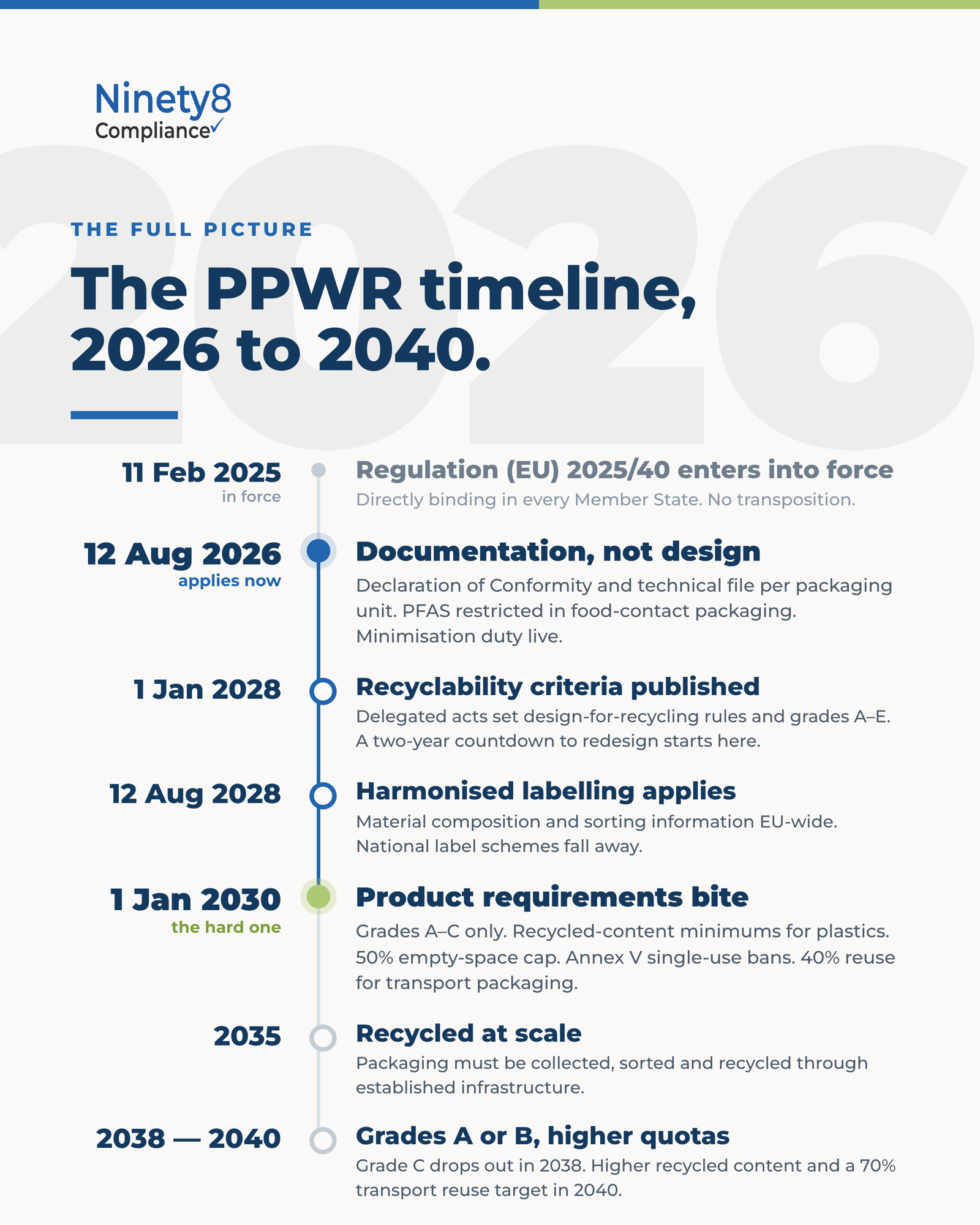
The regulation is deliberately staged. Distinguishing the administrative obligations that apply now from the material and design requirements that arrive later is essential for realistic planning.
From 12 August 2026:
- Declaration of Conformity and supporting technical documentation for every packaging unit
- Packaging minimisation: weight and volume reduced to the minimum necessary for function, safety and hygiene
- Prohibition of packaging designed to create a misleading impression of product volume, including double walls and false bottoms
- PFAS limits in food-contact packaging, and existing heavy metal restrictions carried forward
- Economic operator identification on packaging
- EPR registration in each relevant Member State
- Functioning collection, reconditioning and redistribution systems for any reusable packaging placed on the market
Phasing in thereafter:
- 2028 — harmonised labelling for material composition and separate collection, once the Commission's implementing acts take effect
- 1 January 2029 — deposit return systems, with a 90% separate collection target for single-use plastic bottles and metal beverage containers
- 1 January 2030 — design-for-recycling requirements, minimum recycled content in plastic packaging, the 50% maximum empty space ratio for grouped, transport and e-commerce packaging, Annex V format prohibitions, and reuse targets
- 2035 to 2040 — recycled-at-scale criteria, a higher recyclability performance grade, and increased recycled content and reuse targets
The 50% empty space cap is often misreported as an immediate requirement. It is not; the hard threshold applies from 2030. The minimisation principle behind it, however, applies from August 2026, and market surveillance authorities are likely to treat the 2030 figure as the benchmark against which minimisation is assessed well before it formally bites.
Where Organisations Are Getting Caught
The recurring difficulty is not interpreting the regulation. It is producing the evidence, because the data required to support a Declaration of Conformity almost never sits inside the organisation issuing it.
- The data belongs to suppliers. Recycled content, material composition, recyclability, PFAS and substance-of-concern status are held by packaging converters and resin suppliers. Without a structured request, the response is inconsistent and frequently unusable
- Nobody owns packaging internally. Specification sits with purchasing, artwork with marketing, waste reporting with EHS, and conformity with quality. PPWR requires all four to produce a single defensible file
- Artwork lead times are underestimated. Identification and, later, harmonised labelling changes cascade across every SKU, print plate and pack format
- Scope is drawn too narrowly. PPWR covers sales, grouped, transport, e-commerce and service packaging. Shippers, pallets, wrap, void fill and point-of-sale materials are all in scope
- SME status is assumed to exempt. There is no blanket small-business exemption; limited derogations exist for micro-enterprises under specific articles only
A Proportionate Starting Point
PPWR does not require a new management system. For organisations with a functioning QMS, the controls already exist; what is missing is packaging as a controlled item within them.
- Build a packaging inventory: every format placed on the EU market, mapped to the products and markets it serves
- Determine your economic operator role for each flow, and record the reasoning
- Issue a structured data request to packaging suppliers covering composition, recycled content, recyclability and restricted substances, with a defined response format
- Assess each format against Articles 5 to 12 and rank the gaps by risk and remediation lead time
- Establish a Declaration of Conformity template and a technical file structure before the data arrives, so evidence has somewhere to land
- Bring packaging into existing document control, supplier evaluation and change control, rather than running a parallel system that will not be maintained
Handled this way, PPWR becomes an extension of work most regulated organisations already perform competently. Handled as a separate sustainability exercise, it produces a folder of supplier emails that will not withstand scrutiny.
Positioning for What Follows
The organisations that will manage the 2029 and 2030 requirements without disruption are the ones treating August 2026 as the point at which packaging entered their conformity system. The documentation obligation is modest by comparison with what follows. It is also the structure everything else attaches to.
Ninety8 Compliance supports organisations in building technical files, Declarations of Conformity and supplier evidence programmes that are proportionate, defensible and maintained — across PPWR, CE marking and the wider EU product compliance framework.